Symmetry Of The Periodic Table
Two Equivalent Versions
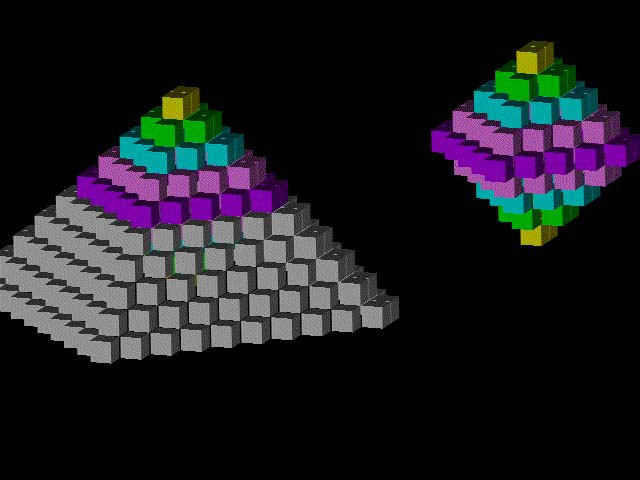
JERIES A. RIHANIThis site has eight webpages, excluding the home webpage, and exhibits two equivalent formats for the symmetry we have here in perspective. It provides a colourful three dimensional image, indicates reserved spaces for extension up to atomic number 170 (a probable maximum limit), and displays three variations for the well established modern periodic table (which may not extend beyond atomic number 120 as the upper and final limit). It also displays The Physicist's Periodic Table by Timothy Stowe, which is a well known formulation whose origin was lost for a long time but was fortunately rediscovered by the scholarly efforts of Eric Scerri. Page seven displays an article by Eric Scerri himself. On page eight, however, you will find two different layouts for The Standard Model which, as you know, is a summary of our understanding of the building blocks of matter (fermions) and the forces that glue them together (bosons). Further, I wish to draw your attention to the fact that, like the Periodic Table Of Elements, The Standard Model is also periodic and has three generations (periods) of fermions (I,II,III) with charge and spin properties repeating for each generation. Amarashiki.
______________________________________________
Click on left image and then open Page 1.
______________________________________________
Page 1 - Symmetry: Original Untrimmed Version
Page 2 - Symmetry: Trimmed Version With Orientation & Spin
Page 3 - Modern Periodic Table: Long Form
Page 4 - Modern Periodic Table: Standard Form
Page 5 - Modern Periodic Table: Separated Form
Page 6A - Physicist's Periodic Table
Page 6B - Stowe's Periodic Table Extended
Page 6C - Janet's Periodic Table
Page 6D - Scerri's Hybrid Periodic Table
Page 7 - How New Elements Are Added?
Page 8 - The Standard Model
WebElements - Mark Winter (University Of Sheffield)
Periodic Table Timeline - Steven Murov
Atomic Orbitals - Periodic Table
Atomic Spectra - Periodic Table
Chemogenesis - Mark Leach
Eric Scerri - UCLA
Is The Periodic Table Perfect ? - Mark Leach Video
"Relativistic Effects in Limiting The Atomic Number of Superheavy Elements"
The above title is that of a paper by Dr. F.W. Giacobbe recently published in the Electronic Journal of Theoretical Physics(www.ejtp.com). In this paper (No.1,2004) the author proposes a "method of estimating the maximum possible atomic number (i.e., Z value) that can be possessed by relatively stable superheavy elements (SHEs). This method is based upon the supposition that no electron orbiting a SHE atomic nucleus can have a speed equal to, or greater than, 0.92c (where c is the speed of light) without significantly increasing the probability of electron capture (i.e., inverse beta decay) by that atomic nucleus. According to this supposition and a relatively simple calculation based upon a two particle Bohr atom model, no stable naturally occurring, or synthetic, chemical elements can exist with atomic numbers greater than 125. This conclusion does not place any limitations on potential nuclear Z values of any possible SHE nucleus. However, it does suggest that stable combinations of SHE nuclei, having Z values greater than 125, and electrons, are unlikely." Abstract, Dr. F.W. Giacobbe, www.ejtp.com, No.1,2004.
This paper was brought to my attention in an e-mail attachment, on June 24, 2004, by my colleague Wolfram Klehr of Apsidium. I replied with the following slightly modified and revised comment: "No doubt, this paper represents a very important development. However, I beleive if the author takes into account the concept of symmetry of the periodic table, as an additional limiting factor, with the rest of the limiting relativistic effects and approximations he has considered, he may find that Z for atoms (not nuclei) may not exceed 120. The periodic table begins with two elements in the s-block and because of its three dimensional symmetry it must end with two element in the same block." dated June 25, 2004.
Few weeks later, on July 19, 2004, and after drawing the author's attention to this web site, Dr. F. W. Giacobbe responded to the preceding comment as follows:
"..Thank you for sending me this web site location. I read the information that was there with interest. Actually, my calculation only predicts a Maximum Z value of about 125. Lower values are probably even more likely, as I mentioned in my paper, because instabilities (i.e., the tendency toward inverse Beta decay) are likely to increase dramatically as Z values approach 125. Taking
into account other effects is certainly likely to drop Maximum Z values even further below 125 as the web site article indicates. In any case, I think time will "tell" but if anyone ever announces Z values for stable nuclei above 125, I would want to see at least a few confirming experimental studies but I don't think that will happen. Thank you again for your note. With Best Regards, FWG .."
_______________________________________________________
The Strong Force Is Short Ranged !!
" why doesn't the repulsion of the interaction between all the positively charged protons blow the nucleus apart? The obvious answer, later borne out by experiments, was that there must be a previously unsuspected attractive interaction that overwhelms the electric repulsion and holds the nucleus together. Because this interaction is stronger than the electromagnetic interaction, it became known as the strong interaction ( or the strong force ). And because no trace of its influence can be detected far away from the nucleus, it was clear that it must have a short range, extending its influence only over the diameter of a large nucleus. This is why there are no nuclie bigger the uranium." John Gribbin, The Universe: A Biography, Penguin Books / Allen Lane, Great Britain, 2007, page 11.
_______________________________________________________
The Strong Force, Quantum Uncertainty, Wave-Particle Duality, & The Tunnel Effect
" When two protons approach one another, the mutual repulsion they feel as a result of their positive charge becomes strong enough to scatter them away from one another long before the strong force gets a chance to act, except under very extreme conditions. In order for two protons to get close enough together for the strong force to take over and make them stick, ejecting a single positron to form a deuteron, the nucleus of deuterium, they have to be moving very fast indeed, which means they have to be in an environment of high temperature and pressure. Such conditions existed, , in the first few minutes of the Big Bang, although that wasn't known in the 1920s. What was known in the mid-1920s was that at a temperature of 'only' 15 million degrees nuclei would not be able to fuse in the way required to provide the energy source of the Sun and other stars, according to the laws of physics known at the time. It was the discovery of quantum uncertainty - new physics - that resolved the dilemma.
" Quantum uncertainty tells us that an entity such as a proton does not have a precise location at a point in space, but is spread out in a fuzzy fashion. In terms of wave-particle duality, you can think of this as an aspect of the wave nature of a 'particle'. Waves are intrinsically spread-out things. So when two protons approach each other, it is possible for their waves to begin to overlap, even though the old physics says that they are not yet touching one another. As soon as the waves mingle in this way, the strong force can get to work, tugging the protons into a tighter embrace and (with the aid of the weak interaction) forcing the ejection of an electron. This process is sometimes called the 'tunnel effect', because the electrical repulsion between two positively charged particles is an insurmountable barrier according to classical physics, and the protons seem to tunnel through the barrier with the aid of quantum uncertainty ( it also works for other particles of course ). When quantum uncertainty came on the scene in the late 1920s, it turned out that it provided just enough opportunity for protons to get together in the heart of the Sun to liberate the energy required to keep the Sun shining." John Gribbin, The Universe : A Biography, Penguin Books / Allen Lane, Great Britain, 2007, pages 130-131.
_______________________________________________________
Two Types Of 3D Bilateral Symmetries
The Physicist's Periodic Table by Timothy Stowe is three dimensional and has two bilateral symmetries: one around the horizontal and the other around the vertical. These symmetries are expected to become complete after the successful synthesis of elements 119 and 120. The bilateral symmetry around the horizon shows that it begins with two elements in the s-block and ends with two elements in the same block. And if experimental efforts to synthesize elements beyond 119 & 120 fail, this bilateral symmetry may indicate that the periodic table has reached an end and that it may not extend beyond those last two elements.
Copyright � 2001-2017 Jeries Rihani. All rights reserved.
